Quick answer: A smart factory connects operational data, analytics, and digital workflows so people, machines, and processes can make faster, better decisions. It’s the practical, shop-floor expression of Industry 4.0. Start with business outcomes and maturity – not sensors or buzzwords.
Manufacturing is under constant pressure to produce more with fewer resources, maintain quality, reduce downtime, and respond quickly to changing customer demands. While many organizations recognize the potential of Industry 4.0 and digital transformation, the term “smart factory” is often surrounded by buzzwords and unrealistic expectations.
The reality is much simpler. A smart factory is not just a collection of sensors, connected machines, or advanced dashboards. It is a manufacturing environment where operational data, people, machines, and processes work together to enable faster and better decision-making.
Rather than starting with technology, successful manufacturers start with business outcomes. A smart factory is the result of a well-planned journey that aligns smart factory solutions and technology investments with measurable operational goals. That means treating the transition as a staged capability build, not a single software purchase.
What Is a Smart Factory?
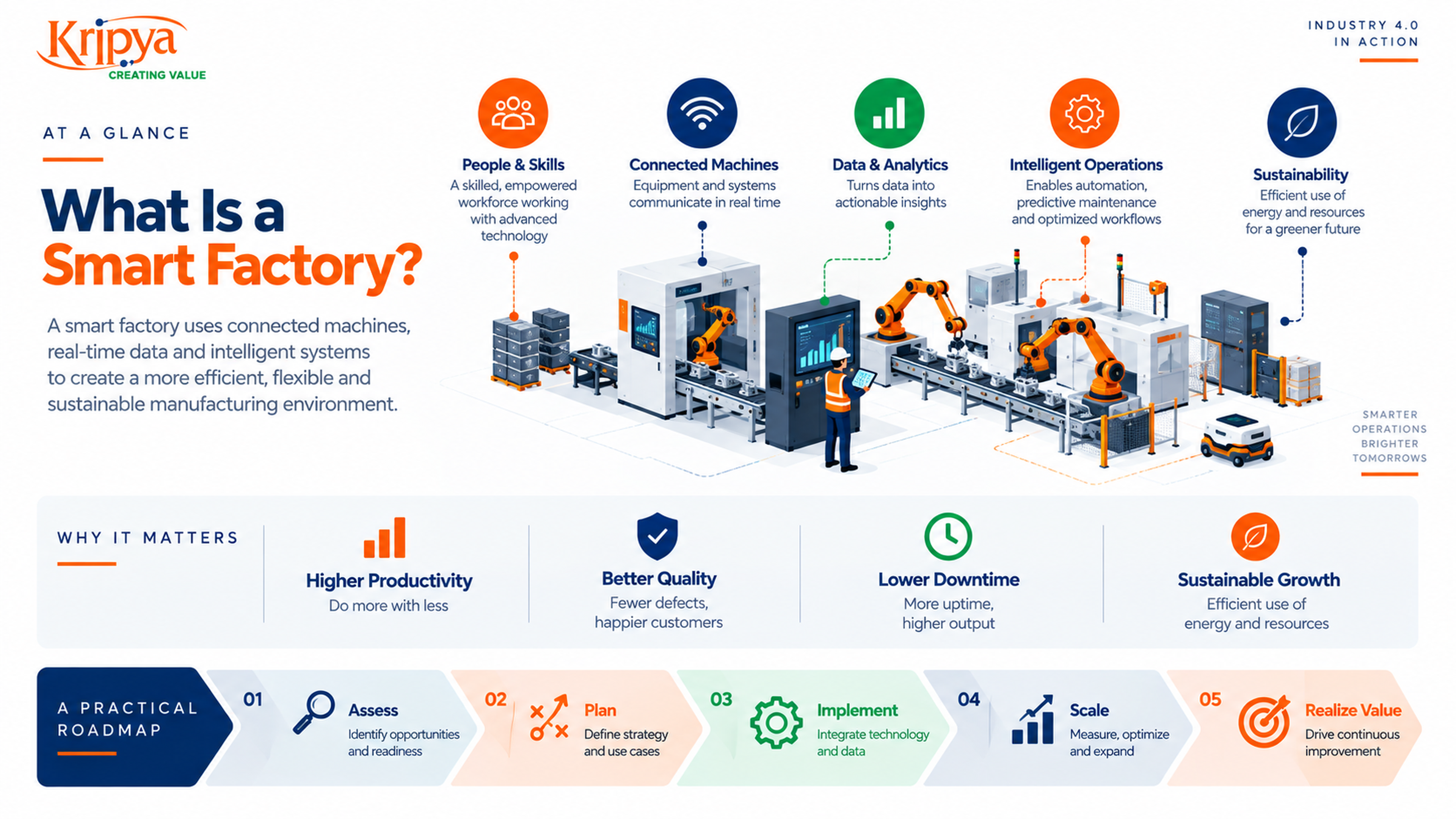
A smart factory is a connected manufacturing facility where machines, systems, and processes continuously exchange information to improve productivity, quality, efficiency, and flexibility.
Unlike traditional factories, where operational data may be trapped in spreadsheets, disconnected software systems, or individual machines, smart factories create a unified view of production operations.
This connectivity enables manufacturers to:
- Monitor production performance in real time
- Reduce equipment downtime
- Improve product quality
- Optimize energy consumption
- Increase production visibility
- Improve maintenance planning
- Respond faster to operational issues
At its core, a smart factory transforms data into actionable insights.
Smart Factory vs. Traditional Manufacturing: What’s the Difference?
Many manufacturers assume that becoming a smart factory requires replacing existing equipment. In reality, most organizations evolve gradually from traditional manufacturing to smart manufacturing.
Traditional Manufacturing
In a traditional environment:
- Data collection is often manual
- Machine performance is difficult to track
- Downtime causes may not be captured accurately
- Quality information is recorded after production
- Maintenance is mostly reactive
- Reports are generated at the end of shifts or days
This creates delays in identifying problems and limits continuous improvement efforts.
Smart Manufacturing
In a smart manufacturing environment:
- Machines automatically generate performance data
- Operators receive real-time visibility
- Production targets can be tracked continuously
- Downtime reasons are categorized and analyzed
- Quality issues are detected earlier
- Maintenance teams receive alerts before failures occur
The result is better operational control and more informed decision-making.
Key Components of a Smart Factory
Building a smart factory requires several interconnected capabilities.
1. Connected Machines and Equipment
The foundation of any smart factory is machine connectivity. Production assets generate valuable operational data including:
- Production counts
- Machine status
- Downtime events
- Cycle time information
- Energy consumption
- Process parameters
When connected, these assets provide the visibility needed to understand actual plant performance. Kripya’s IoT and Industry 4.0 services help manufacturers connect legacy and modern equipment without a full retrofit.
2. Real-Time Production Monitoring
Real-time production monitoring helps operations teams track production targets versus actual output and Overall Equipment Effectiveness (OEE) — the combined measure of:
- Availability
- Performance
- Quality
- Production losses
Instead of waiting for daily reports, managers can identify issues as they occur.
3. Data Analytics
Collecting data alone does not create value. Analytics helps manufacturers answer critical questions:
- Which machines experience the most downtime?
- What are the top causes of production losses?
- Which shifts perform best?
- How is quality impacting productivity?
- What trends indicate future problems?
Data analytics turns operational information into business intelligence.
4. Predictive and Preventive Maintenance
Unplanned downtime remains one of the largest cost drivers in manufacturing. Smart factories use machine data and condition monitoring to move from reactive maintenance to proactive maintenance strategies.
By monitoring factors such as:
- Vibration
- Temperature
- Pressure
- Machine utilization
- Component life cycles
maintenance teams can identify risks before failures occur. Component life-cycle data, often managed through Kripya’s PLM expertise (Teamcenter, NX, Solid Edge), feeds directly into predictive maintenance models — improving equipment reliability while reducing maintenance costs.
5. Energy Management
Energy costs continue to rise across manufacturing sectors. A smart factory provides visibility into:
- Energy consumption by machine
- Energy consumption by production line
- Peak load patterns
- Energy efficiency per unit produced
This helps organizations reduce waste and identify opportunities for cost savings.
6. Digital Workflows
Many factories still rely on paper forms and manual approvals. Digital workflows streamline activities such as:
- Maintenance requests
- Quality inspections
- Downtime reporting
- Production tracking
- Corrective actions
- Compliance documentation
Digital processes improve traceability while reducing administrative effort.
Benefits of a Smart Factory
The value of a smart factory goes beyond technology implementation.
Increased Productivity
Real-time visibility helps teams identify bottlenecks quickly and improve throughput without significant capital investments — see how this played out in Kripya’s production efficiency case study for an American automotive and e-mobility supplier.
Reduced Downtime
Predictive maintenance and downtime analysis help prevent unexpected production interruptions. Flagging early warning signs — vibration drift, temperature spikes — lets teams schedule repairs before a line stops.
Improved Quality
Continuous monitoring enables earlier detection of process deviations and defects. Catching a deviation within minutes, rather than at end-of-shift inspection, keeps scrap and rework contained to a handful of parts.
Better Decision-Making
Managers gain access to reliable operational data instead of relying on assumptions or delayed reports. Shift supervisors, plant managers, and quality teams work from the same numbers instead of conflicting spreadsheets.
Lower Operating Costs
Improved resource utilization, energy efficiency, and maintenance planning contribute to cost reductions. Savings typically come from three places: less unplanned downtime, tighter energy use, and fewer scrapped parts.
Greater Manufacturing Agility
Connected operations allow manufacturers to respond more quickly to customer demands, supply chain changes, and production disruptions — agility that matters most during demand spikes or a customer’s mid-order spec change.
A Practical Smart Factory Roadmap
One of the biggest mistakes manufacturers make is focusing on technology before defining objectives. A practical roadmap begins with business priorities.
Step 1: Assess Current Maturity
Start by understanding your current state. Evaluate:
- Machine connectivity
- Production visibility
- Data collection processes
- Maintenance practices
- Reporting capabilities
- Workforce readiness
This creates a baseline for future improvements.
Step 2: Define Business Outcomes
Identify the outcomes you want to achieve. Examples include:
- Reducing downtime by 20%
- Increasing OEE by 10%
- Lowering energy consumption
- Improving first-pass yield
- Reducing maintenance costs
Business goals should drive technology decisions.
Step 3: Connect Critical Assets
Rather than connecting every machine immediately, focus on critical production assets first. Prioritize equipment that has the greatest impact on:
- Throughput
- Quality
- Downtime
- Energy consumption
Quick wins help build organizational momentum.
Step 4: Create Operational Visibility
Implement dashboards and reporting tools that provide visibility into production performance. Focus on key metrics such as:
- OEE
- Downtime
- Production output
- Rejection rates
- Energy consumption
Visibility is often the fastest way to unlock improvements.
Step 5: Standardize Processes
Create consistent workflows for:
- Downtime tracking
- Maintenance activities
- Quality reporting
- Production planning
Standardization improves data quality and decision-making accuracy.
Step 6: Introduce Advanced Analytics
Once reliable data is available, begin leveraging analytics to uncover trends and improvement opportunities. Advanced analysis can reveal:
- Recurring failure patterns
- Hidden production losses
- Capacity constraints
- Quality issues
- Inefficient operating practices
Step 7: Scale Across the Factory
After demonstrating success in one area, expand the approach across additional lines, plants, and operations. This phased approach reduces risk while maximizing return on investment — it’s the same sequence behind Kripya’s smart factory transformation for a leading Indian shaft manufacturer, who connected critical assets first and scaled smart manufacturing from there.
Common Smart Factory Challenges
Despite the benefits, manufacturers often encounter obstacles. Common challenges include:
- Legacy equipment integration
- Data silos
- Limited visibility into operations
- Resistance to change
- Skill gaps
- Unclear ROI expectations
The most successful organizations address these challenges by focusing on measurable business outcomes rather than technology for its own sake.
Smart Factory Success Starts with Strategy
The journey toward smart manufacturing is not about deploying the latest technology. It is about creating a connected and data-driven operation that helps people make better decisions.
Manufacturers that begin with clear business goals, assess their maturity, and implement improvements in stages are far more likely to achieve sustainable results. A smart factory is not a destination reached overnight. It is an ongoing transformation that combines technology, process improvement, and operational excellence.
CentralStage, Kripya’s IoT and Industry 4.0 platform, helps manufacturers build this transformation by connecting machines, production, quality, maintenance, energy, and operational workflows into a unified smart factory platform. Combined with Kripya’s full-stack manufacturing expertise — PLM, IoT, and digital engineering — it gives manufacturers a single partner for the full journey.
→ Talk to a Kripya smart factory specialist to assess your maturity and build your roadmap, or explore more manufacturing insights on Kripya’s blog.
Frequently Asked Questions
What is a smart factory in simple terms?
A smart factory is a manufacturing facility where machines, data systems, and people are connected so decisions can be made in real time — instead of relying on manual reports and disconnected spreadsheets.
What’s the difference between a smart factory and smart manufacturing?
“Smart factory” usually refers to one specific connected facility, while “smart manufacturing” describes the broader strategy — data, analytics, and digital workflows — applied across one or more factories.
Do I need to replace my existing equipment to build a smart factory?
No. Most manufacturers connect existing machines using sensors, gateways, and IoT platforms rather than replacing equipment outright. A phased approach that starts with critical assets is the most common path.
How long does it take to become a smart factory?
There’s no fixed timeline — it depends on current maturity and scope. Most manufacturers see measurable results within a few months of connecting critical assets and building visibility, then scale over 12–24 months.
What is OEE and why does it matter in a smart factory?
Overall Equipment Effectiveness (OEE) combines availability, performance, and quality into one score that shows how effectively equipment is actually being used. It’s one of the most commonly tracked metrics in smart factory dashboards.
Where should manufacturers start?
Start with business outcomes and maturity — not sensors or buzzwords. Assess your current state, define the outcomes you want (like reduced downtime or higher OEE), then connect the assets that matter most.
What technology do I need to get started?
Most manufacturers start with lightweight IoT sensors or existing machine controllers connected through a gateway, paired with a real-time dashboard. Systems like MES, PLM, and ERP typically get integrated later, once the data foundation is proven.