Quick Answer: PLM implementation typically costs between $50,000 and $250,000+ for small to mid-size manufacturers, and $500,000 to several million dollars for large enterprises, depending on deployment model, user count, customization depth, and integration scope. Software licensing usually accounts for only 30–40% of the total — the remaining 60–70% comes from implementation services, customization, data migration, integration, training, and ongoing support.
If you’re evaluating Product Lifecycle Management (PLM) for your manufacturing business, the sticker price of the software is only the beginning of the story. Understanding the full cost — phase by phase — is the difference between a PLM program that delivers ROI and one that stalls halfway through the budget.
In this guide, we break down PLM implementation cost across the seven phases every manufacturer goes through, the hidden costs that derail budgets, and proven strategies to reduce your total cost of ownership (TCO).
What Drives PLM Implementation Cost?
Before the phase-by-phase breakdown, it helps to understand the five factors that most influence what you’ll pay:
- Deployment model — Cloud/SaaS PLM shifts cost from large upfront capital expenditure to predictable subscription fees, while on-premise deployments require infrastructure, IT staffing, and periodic upgrade projects.
- Number and type of users — Full authoring licenses (engineering) cost significantly more than viewer or contributor licenses (procurement, quality, suppliers).
- Customization vs. configuration — Out-of-the-box configuration is fast and affordable. Heavy custom code is the single biggest driver of cost overruns and painful future upgrades.
- Integration scope — Connecting PLM to ERP, MES, CRM, and IoT systems adds cost — but skipping integration creates data silos that cost far more over time.
- Data complexity — Decades of legacy CAD files, BOMs, and documents scattered across shared drives require cleansing and structured migration.
PLM Cost Breakdown by Implementation Phase
Here is what manufacturers should budget for at each of the seven PLM implementation phases, with typical cost allocation as a percentage of total project cost.
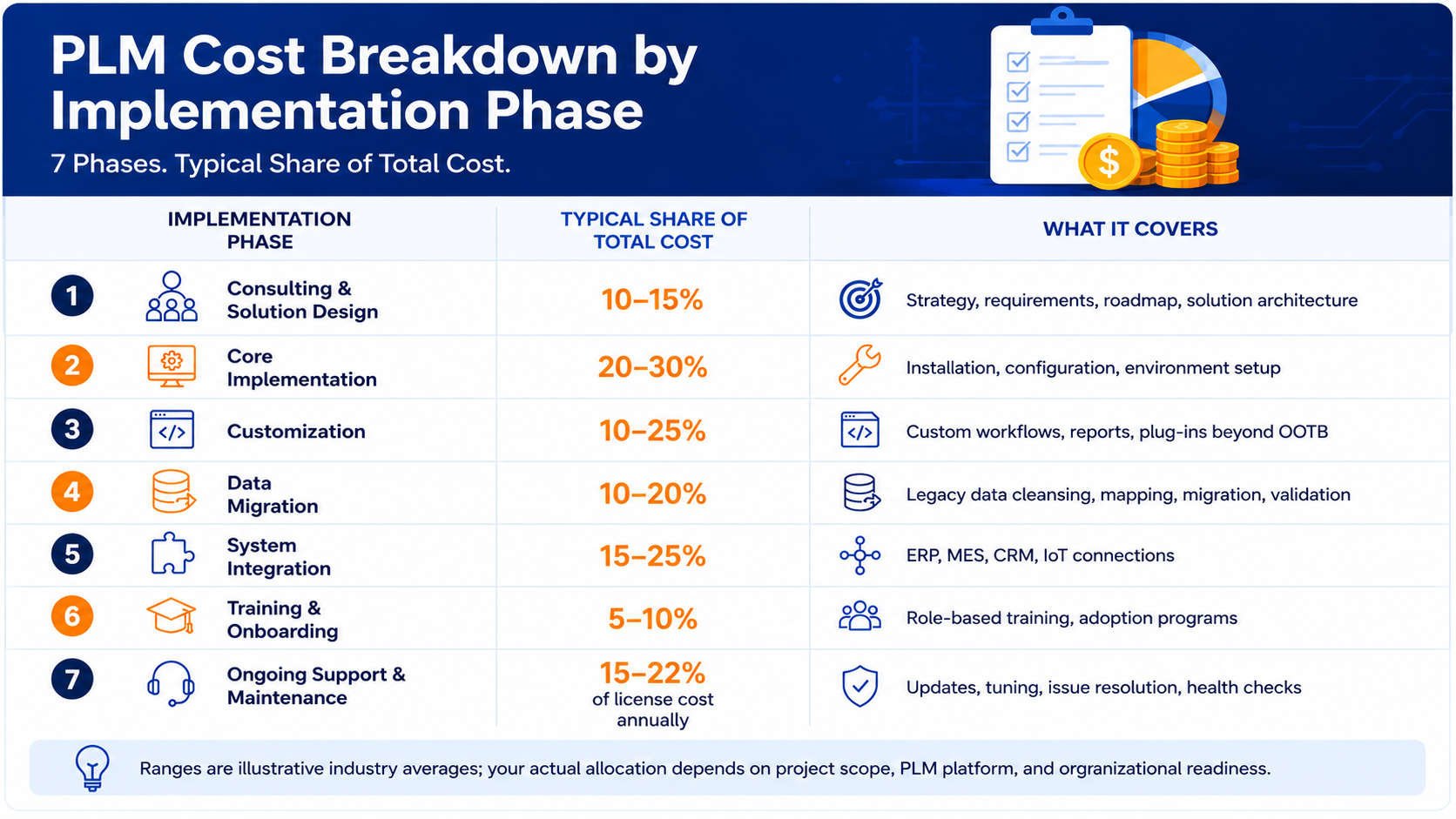
Ranges are illustrative industry averages; your actual allocation depends on project scope, PLM platform, and organizational readiness.
Phase 1: Consulting and Solution Design (10–15% of project cost)
Every successful PLM program starts with strategy — not software. This phase covers current-state assessment, requirements gathering, process mapping, platform selection support, and a phased implementation roadmap.
Why it’s worth it: Manufacturers who underinvest here routinely pay 2–3x more later in change requests and rework. A well-designed solution architecture prevents scope creep, the most common cause of PLM budget overruns.
Cost-saving tip: Choose a partner who plans for both your stated and unstated requirements — the gaps you don’t see today become the change orders of next year.
PLM & IoT Consulting Services →
Phase 2: Core Implementation (20–30% of project cost)
This is the build phase: installing the platform (cloud or on-premise), configuring data models, setting up user roles and permissions, establishing workflows for change management and BOM control, and standing up development, test, and production environments.
What influences cost: Platform choice, number of modules deployed in the first phase, and whether you take a “big bang” or phased rollout approach. A phased approach — starting with core PDM/BOM and change management, then expanding — spreads cost and dramatically improves adoption.
Enterprise Implementation & Customization →
Phase 3: Customization (10–25% of project cost — and the biggest wildcard)
Customization covers anything beyond out-of-the-box capability: custom workflows, company-specific plug-in tools, and custom reports for needs that standard configuration can’t meet.
The warning every manufacturer should hear: Over-customization is the #1 PLM budget killer. Every line of custom code adds cost now and compounds cost at every future upgrade. Best practice is to configure first, customize only where there’s clear business value, and increasingly use low-code approaches that let domain experts build lightweight apps and workflows without expensive custom development.
Rule of thumb: If customization exceeds 25–30% of your implementation budget, revisit the requirements — you may be paving over broken processes instead of fixing them.
Low-Code PLM White Paper →
Phase 4: Data Migration (10–20% of project cost)
Your PLM system is only as good as the data inside it. This phase covers extracting legacy data (CAD files, BOMs, specifications, documents), cleansing duplicates and errors, mapping to the new data model, migrating in controlled batches, and validating results.
The hidden cost most manufacturers miss: Data cleansing. Companies routinely discover that 20–40% of legacy product data is duplicated, outdated, or incomplete. Budgeting for cleanup before migration is far cheaper than polluting your new system and fixing it after go-live.
Also budget for: Migration of customer-specific configuration when upgrading from an older PLM version — a frequently underestimated line item in upgrade projects.
Phase 5: System Integration — PLM with ERP, MES, CRM, and IoT (15–25% of project cost)
PLM delivers its full value only when connected to the rest of your enterprise: ERP for item and BOM handoff to manufacturing, MES for shop-floor execution, CRM for customer requirements, and IoT platforms for real-world product performance data.
Why integration cost varies so widely: Traditional point-to-point integrations are cheap to start but create brittle “spaghetti” architectures that cost heavily to maintain. An API-first integration approach costs somewhat more upfront but delivers secure, reusable data flows that eliminate silos and cut long-term integration TCO significantly.
The IoT dimension: Manufacturers connecting shop-floor data into PLM gain real-time insights — machine connectivity, live dashboards, and predictive analytics — that turn PLM from a documentation system into a decision-making engine.
PLM Integration Services → | CentralStage IIoT Platform →
Phase 6: Training and Onboarding (5–10% of project cost)
The most technically perfect PLM implementation fails if engineers keep working in spreadsheets. Training covers role-based content creation and delivery — both customer-specific and generic — plus onboarding programs, UAT support, and adoption tracking.
Why skimping here is expensive: Industry analysts consistently attribute the majority of failed PLM projects to poor user adoption, not technology failure. Personalized training and structured onboarding are the cheapest insurance policy in your entire PLM budget.
Phase 7: Ongoing Support and Maintenance (15–22% of license cost, annually)
PLM is not a one-time project — it’s a living platform. Annual costs include software maintenance or subscription renewal, performance tuning, issue resolution, regular system health checks, minor enhancements, and periodic version upgrades.
Managed services option: Many manufacturers reduce this cost by moving from in-house administration to a managed services model — converting unpredictable internal IT effort into a predictable operating expense while gaining access to specialist expertise.
Managed Services & Support →
PLM Implementation Cost by Company Size
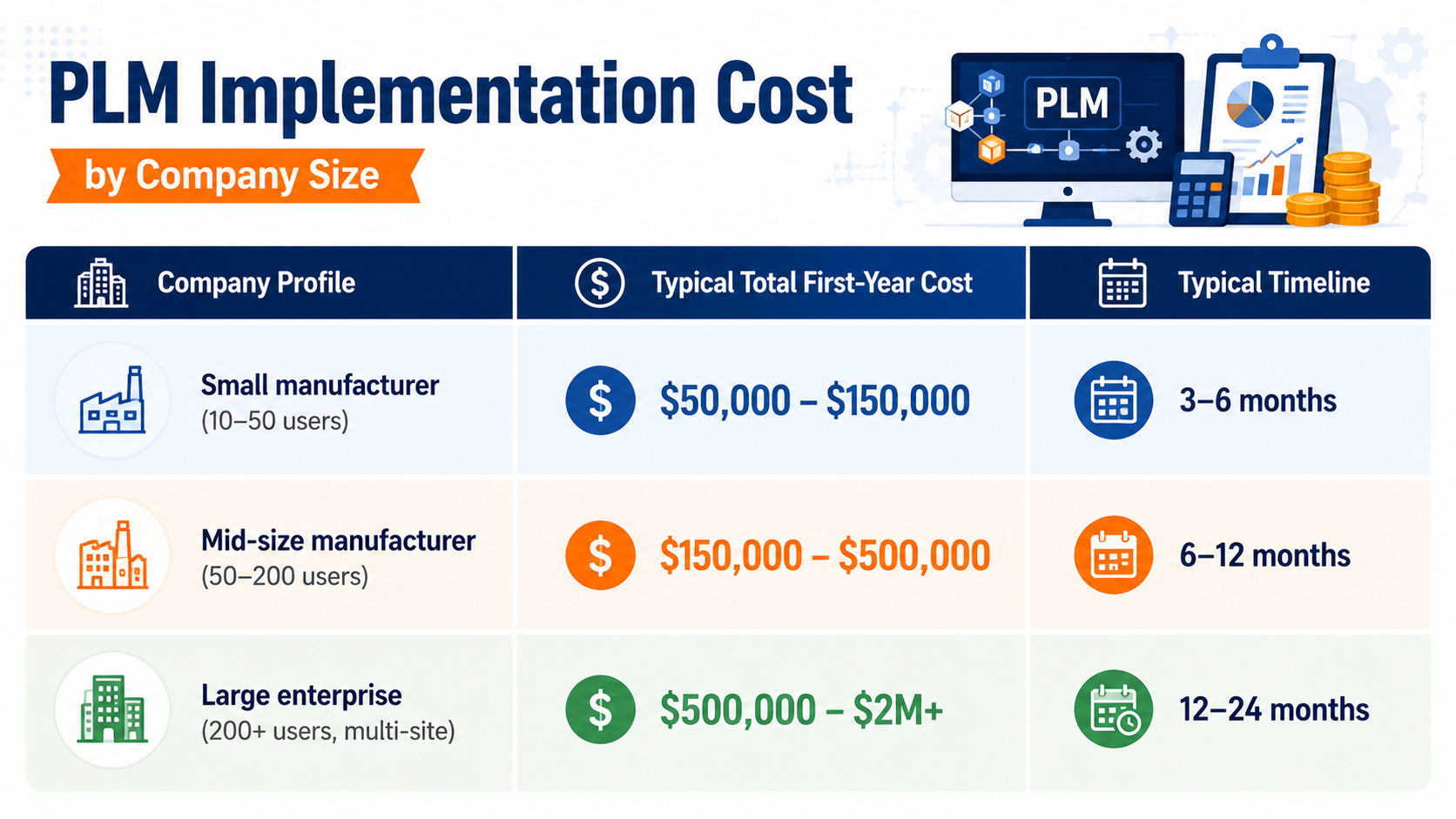
Figures are indicative industry ranges combining licensing/subscription and services; actual costs depend on platform, scope, region, and deployment model. Request a tailored assessment for accurate budgeting.
5 Hidden PLM Costs Manufacturers Overlook
- Legacy data cleanup — often discovered mid-project, when it’s most expensive
- Over-customization debt — every custom object adds cost to every future upgrade
- Change management — process redesign and stakeholder alignment take real effort
- Internal resource time — your engineers and IT staff will spend meaningful hours on the project
- Integration rework — poorly architected point-to-point integrations that must be rebuilt within 2–3 years
How to Reduce PLM Total Cost of Ownership: 6 Proven Strategies
- Phase your rollout — start with core PDM, BOM, and change management; expand after adoption is proven
- Configure before you customize — challenge every customization request against out-of-the-box capability
- Adopt low-code tools — empower “citizen developers” to build lightweight workflows, offloading 30–40% of simple IT requests
- Choose API-first integration — pay a little more upfront to avoid rebuilding brittle integrations later
- Clean data before migration — cleansing legacy data pre-migration costs a fraction of post-go-live remediation
- Invest in training — adoption is the ultimate ROI multiplier; an unused system is 100% wasted cost
The ROI Side of the Equation
Cost is only half the calculation. Manufacturers with well-implemented PLM typically report:
- Faster time-to-market through streamlined engineering change and release processes
- Reduced engineering rework from a single source of product truth
- Fewer BOM errors reaching the shop floor
- Shorter ECO cycle times, often reduced from weeks to days
- Better collaboration across engineering, manufacturing, procurement, and suppliers
For most manufacturers, PLM investments reach payback within 12–24 months when implementation follows a phased, adoption-focused approach.
Frequently Asked Questions About PLM Implementation Cost
How much does PLM implementation cost for a small manufacturer?
Small manufacturers (10–50 users) typically invest $50,000–$150,000 in the first year, covering subscription licensing, implementation services, basic data migration, and training. Cloud/SaaS deployment with a phased rollout keeps entry costs lowest.
What percentage of PLM cost is software licensing vs. services?
Licensing typically represents 30–40% of total first-year cost. The remaining 60–70% covers consulting, implementation, customization, data migration, integration, and training. Budgets that only account for license fees underestimate the real investment by roughly half or more.
How long does PLM implementation take?
A focused first phase takes 3–6 months for small manufacturers, 6–12 months for mid-size companies, and 12–24 months for multi-site enterprise deployments. Phased rollouts deliver usable value much earlier than “big bang” approaches.
Is cloud PLM cheaper than on-premise PLM?
Cloud PLM has significantly lower upfront cost (no servers, no infrastructure project) and predictable subscription pricing, making it cheaper for most small and mid-size manufacturers over a 3–5 year horizon. On-premise can be competitive for very large enterprises with existing infrastructure and strict data residency requirements.
What is the biggest cause of PLM cost overruns?
Over-customization. Custom code inflates initial cost and compounds at every upgrade. The second biggest cause is underestimating data migration — specifically the cleansing of decades of legacy product data.
How much does PLM integration with ERP or MES cost?
Integration typically consumes 15–25% of total project cost, depending on the number of systems and the architecture chosen. API-first integration approaches cost more initially but substantially reduce long-term maintenance compared to point-to-point connections.
How can I reduce PLM implementation cost without cutting corners?
Phase your rollout, configure instead of customize wherever possible, adopt low-code tools for lightweight workflows, clean your data before migration, and invest properly in training — adoption failures waste more money than any other single factor.
Get an Accurate Number for Your PLM Project
Industry ranges are useful for budgeting — but your actual PLM implementation cost depends on your product complexity, legacy data, integration landscape, and rollout strategy.
Kripya has delivered PLM implementations, customizations, migrations, and integrations for manufacturers across the globe since 2006 — from focused first-phase deployments to complex multi-system enterprise programs.
👉 Request Your Free PLM Cost Assessment
Get a tailored, phase-by-phase cost estimate for your specific situation — including deployment recommendations, integration architecture, and a realistic timeline. No obligation.
Book Your Free PLM Cost Assessment →