A few years back, putting everything on one cloud provider felt like the smart, boring choice. One contract. One console. One team to train up. If something broke, you knew exactly who to call. For a lot of companies, that made perfect sense at the time.
It doesn’t feel quite so simple anymore. Renewal comes around and there are fewer real options on the table than there used to be. You’d like to test another provider, but the egress fees alone make that a hard sell to finance. A pricing change lands in your inbox, and there’s no realistic alternative except to absorb it. The thing that used to feel like simplicity now feels a lot more like dependency.
That’s vendor lock-in, and it’s one of the more underrated risks sitting inside most enterprise IT strategies.
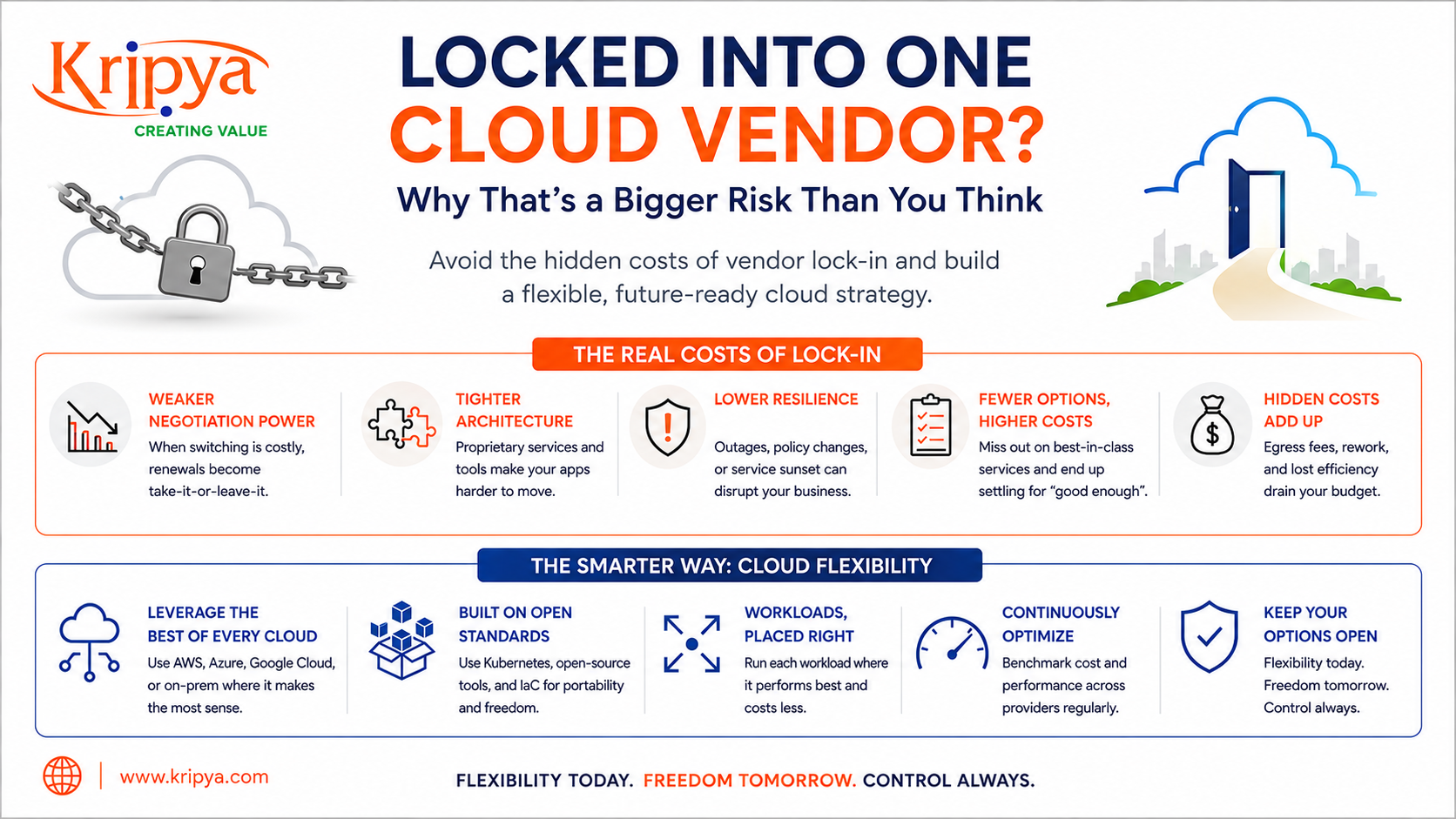
What It Actually Costs You
Lock-in doesn’t happen in one dramatic moment. It builds up slowly, through a hundred small decisions, until one day you realize you don’t really have a choice anymore.
Your Negotiating Position Erodes
The first thing to go is your negotiating position. When a provider knows how expensive it would be for you to leave, the renewal conversation stops being a negotiation and starts being a formality – you’re told what’s changing, not asked. Price increases, tweaked SLAs, deprecated services: they get accepted because the alternative, a full migration, seems like more trouble than it’s worth.
Your Architecture Gets Harder to Untangle
Then there’s the architecture itself. The more your applications lean on a provider’s proprietary databases, serverless frameworks, or managed tooling, the harder it gets to ever move them. What looked like a convenient shortcut two years ago is now a dependency baked straight into the codebase.
Your Resilience and Options Shrink
There’s also the resilience question, which people tend to underweight until something actually goes wrong. A regional outage, a service getting sunset, a policy change you didn’t see coming – any of it can knock your operations sideways if there’s no fallback. And on a less dramatic note, you’re also giving up access to whatever each provider does best. One might have stronger AI tooling, another better data analytics, a third the compliance certifications your industry actually needs. Stick to one vendor for everything and you end up settling for “good enough” instead of picking the right tool for each job.
None of this shows up as a line item. It shows up later, usually at the exact moment you need flexibility and discover you don’t have any.
The Alternative Isn’t “Leave Your Provider” – It’s Keeping the Option Open
Going cloud-agnostic doesn’t mean ripping everything out and starting over. It means building things so that you could move if you needed to — and having that option is often worth more than actually using it.
What “Cloud-Agnostic” Actually Means
In practice, this means spreading workloads and architectural decisions across AWS, Azure, and Google Cloud (plus on-prem or VMware where it still makes sense) based on what each platform is genuinely good at, rather than defaulting to whatever your primary provider happens to offer.
How It Plays Out in Practice
A few things tend to come up when companies actually do this well. Not every application needs to move, and the ones that do don’t all need to move the same way — some are fine as a straightforward lift-and-shift, others are worth re-architecting into containerized, microservices-based systems that can run more or less anywhere. Wherever it’s practical, teams lean on open standards, Kubernetes, and infrastructure-as-code instead of provider-specific tooling, so a future move doesn’t turn into a rebuild from scratch. Some workloads end up split across environments on purpose — sensitive data staying on-prem, compute-heavy jobs going wherever pricing is best, AI workloads running on whichever platform has the strongest tooling for it. And instead of only comparing providers once a year at renewal time, teams that do this well are benchmarking cost and performance more or less continuously.
None of this is complexity for its own sake. It’s about giving yourself options, so decisions get made based on what’s actually best for the business instead of what’s easiest given wherever your infrastructure happens to already live.
Doing This Without Blowing Up the Business
This is usually where the hesitation sets in, and honestly, it’s a fair concern. A migration that causes downtime, breaks half your integrations, or drags on for a year and a half does more damage to the business than the lock-in it was meant to fix.
The Playbook Companies Actually Follow
Companies that pull this off tend to follow roughly the same playbook. They start with an honest readiness assessment — mapping out what’s running where, what depends on what, and which workloads are carrying the most lock-in risk versus which ones would deliver value fastest if moved. From there, they pick a migration approach per application rather than a one-size-fits-all plan: some things get lifted and shifted for a quick win, others get modernized in parallel because it’s worth the extra investment. The actual cutover happens in phases, with real testing and a rollback plan, because the business still has to run while all of this is happening. And critically, the work doesn’t stop at go-live — someone has to keep monitoring, tuning, and securing the new environment, or all that flexibility gets eaten up by neglect within a year.
How Kripya Helps
This is the kind of work Kripya does day to day – helping enterprises get out from under single-vendor dependency without putting the business at risk in the process.
Migration: Cloud Solutions
On the migration side, Kripya works as a cloud-agnostic partner across AWS, Azure, Google Cloud, and VMware, so the path chosen for each workload is based on what that workload actually needs, not on which platform Kripya happens to push. That starts with assessing cloud readiness against both the technical realities and the business goals before anything gets touched. From there, it’s a mix of automated, cross-platform deployment tooling that’s reusable rather than rebuilt for every migration, and hands-on execution — from simple lift-and-shift moves to full modernization, depending on the system — backed by a team with a track record of landing these projects on time and on budget.
After Go-Live: Managed Services
The part that’s easy to overlook is what happens after the migration is done. A multi-cloud or hybrid setup that isn’t actively managed can end up harder to run than the single-vendor environment it replaced. That’s where Kripya’s managed services come in – a cloud roadmap tied to actual business goals rather than generic best practices, 24×7 monitoring and incident response, ongoing security and compliance oversight, and continuous cost and performance optimization so the environment doesn’t quietly drift back into the kind of mess it was supposed to prevent.
FAQs
What is cloud vendor lock-in, in plain terms? It’s when you’re so dependent on one provider’s infrastructure, tools, or pricing that switching becomes genuinely difficult – technically, financially, or both – even in situations where switching would clearly be the right business call.
Isn’t multi-cloud the same thing as cloud-agnostic? Close, but not quite. Multi-cloud just means you’re using more than one provider somewhere in the business. Cloud-agnostic is a step further – it means your applications are built so they could run on a different provider without a major rewrite, whether or not you’re actually using more than one today.
Does going cloud-agnostic mean giving up a provider’s best features? Not really. It’s more about being intentional – knowing where you’re using proprietary services on purpose versus where you’re locking yourself in without meaning to. You can still take advantage of what a platform does best without becoming permanently stuck there.
Is a cloud-agnostic migration more expensive than just staying put? Depends entirely on the workload. Some applications make sense as a cheap, quick lift-and-shift. Others are worth the extra spend on modernization because of what it saves you later. That’s usually the first thing worth figuring out – application by application, not as a blanket policy.
How long does something like this actually take? It really varies – how many applications, how complex they are, whether they’re being modernized or just moved as-is. Most companies phase it, starting with lower-risk workloads to get some early wins before tackling anything complicated.
Once you’re migrated, doesn’t managing multiple clouds just become the new headache? It can, if nobody’s actively running it. That’s really the whole point of pairing migration with ongoing managed services – monitoring, security, cost control – so the flexibility you just paid for doesn’t quietly erode six months later.
The Real Question
Avoiding lock-in isn’t about distrusting your cloud provider or adding complexity because it sounds sophisticated. It’s about making sure that when something changes – pricing, performance needs, compliance requirements, or just a better option showing up – you’re actually able to respond, instead of being stuck with a decision someone made years ago under completely different circumstances.
If you’re not sure how exposed your current setup is, that’s usually the first thing worth finding out – Kripya’s team can walk through what a cloud-agnostic assessment would look like for your environment.